

Mixed Bouquet Pricing: Why It Feels So Hard — and What Actually Works
It was 4am on the morning of my very first farmers market when I realized I could no longer avoid the problem.
It had taken me most of the night to harvest and prep my flowers because I couldn’t start that part until I finished my day job on Friday evening. I was running on such a potent mix of adrenaline, anxiety, and excitement that sleeping wasn’t an option.
And then it hit me.
I needed signs.
Which meant I needed to write prices on them.
I’d pushed pricing out of my mind as I prepared for market day. I made checklists for everything else. Not just the tent, tables, and cash box, but every small detail I could think of that might go wrong. I checked and re-checked those lists.
Now, with everything else done and no way around it, the thing I’d been avoiding was suddenly unavoidable.
I had to decide what prices to charge.
Pricing Panic and the Signs I Didn’t Want to Make
So I scrambled. I pulled out my laptop and went looking for answers.
I skimmed industry resources from places like the Association of Specialty Cut Flower Growers and pulled information from the United States Department of Agriculture. The best I could find was broad guidance around markup ranges (things like “weddings have the highest markup—four times the wholesale price of a stem”; or the price for a bunch of imported lisianthus). Useful in theory, but nothing that helped me turn buckets of blooms into prices I could write on those signs with confidence.
So I did what a lot of growers do in that moment. I pieced together what I could and made my best guess.
Then I freaked out.
That seems too high. No one will buy my bouquets if I charge that much.
I changed the signs. Then another thought crept in. Can I make any money if I sell my flowers at these prices?
I changed the signs again. Then lowered them again. Raised them.
None of those changes were based on new information. They were based purely on fear.
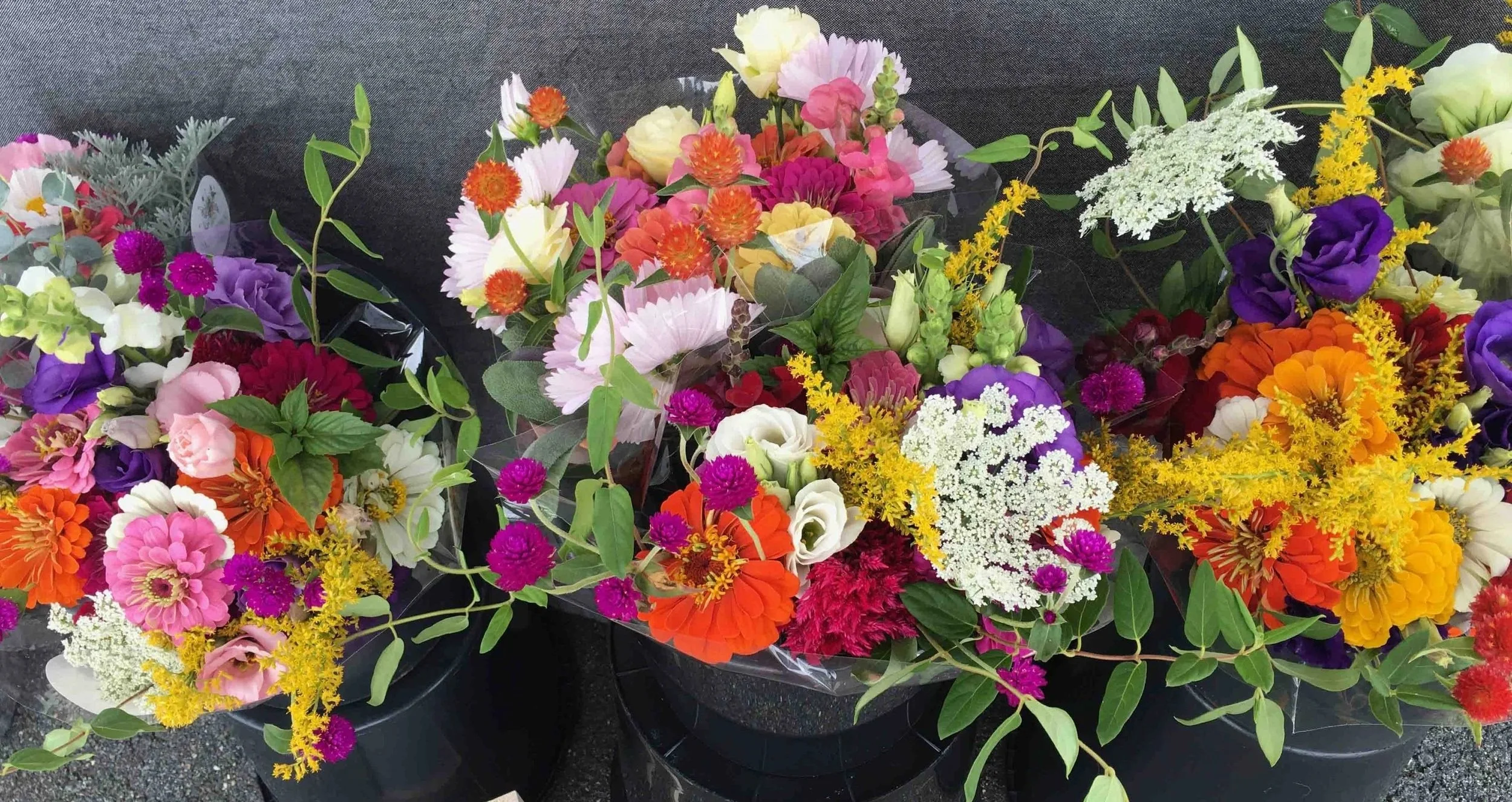
The mixed bouquets from my very first farmers market. I’ve come a very long way in terms of my pricing knowledge and confidence since then (and I’ve also come a very long way in terms of my bouquet design…).
The Two Bouquet Pricing Myths that Don’t Help
Over the years, I’ve realized that most pricing advice falls into two main camps.
The first is some version of: You’re probably charging too little.
That may be true. It often is. But it’s not helpful. It doesn’t tell you what to charge or how to get there. Guilt is not a pricing strategy.
The second is the advice to calculate your cost per stem.
For some growers, that works beautifully. If you’re growing a large volume of a small number of crops, you can track inputs, labor, and output with reasonable accuracy.
But if you’re growing for mixed bouquets, that advice falls apart quickly.
When you’re producing dozens of varieties, sometimes in very small quantities, the math becomes absurd. I only need a handful of dill plants to get enough of those charming, fireworks-like yellow flowers for my mixed bouquets, for example. How much of my time spent weeding last summer went into those few plants versus the cosmos or the gomphrena? If my lisianthus requires netting but my rudbeckia doesn’t, how do I accurately assign that extra material and labor? How do I divide up the time I spend fixing drip irrigation between crops that use tons of water and those that need almost none?
The time spent trying to track and allocate costs at that level is unreal — and it quickly becomes counterproductive. The mental load alone can undo any benefit the data might provide.
The Pricing Puzzle I Couldn’t Let Go Of
I’ve written elsewhere about how the Bouquet Blueprint framework came to be. By grouping flowers into consistent functional roles and using seasonal recipes, the Blueprint made it possible to build bouquets that were flexible, creative, and still predictable.
That structure mattered — because it meant I was no longer pricing from scratch every time I built a bouquet.
But it didn’t fully solve pricing. Not yet.
Thinking about the pricing problem crept into my head in the way the most interesting challenges always do — while in the shower, or the car, or while dropping impossibly tiny snapdragon seeds onto soil blocks. The kind of problem your brain keeps turning over even when you’re not trying to solve it.
One of the things that kept nagging at me was how much effort I was putting into calculating prices from scratch — as if no one else had ever priced a flower before.
Then it hit me. Markets (not the farmers market — I mean national and international marketplaces of commerce) already do an enormous amount of pricing work for us. Large, mature markets compress massive amounts of information into usable signals. Wholesale flower prices aren’t random. They’re shaped by thousands of real transactions, across time and geography.
They’re not perfect, and they’re not prescriptive. But they are disciplined by volume in a way no single farm’s records ever could be.
Realizing I could use those market-honed prices as reference points — instead of inventing everything myself — was when the second big piece of the puzzle started to slip into place.
Of course, those reference prices don’t know anything about my farm — or yours.
They don’t know your labor structure, your overhead, your efficiency, your scale, or your constraints. Two growers can build the same bouquet with very different economics underneath.
So the next challenge wasn’t choosing between “market prices” and “farm reality.” It was figuring out how to translate one into the other — without trying to assign costs to every stem, every minute, or every plant.
Slowly, a pattern emerged. I did a lot of scribbling on notepads and typing formulas into the computer.
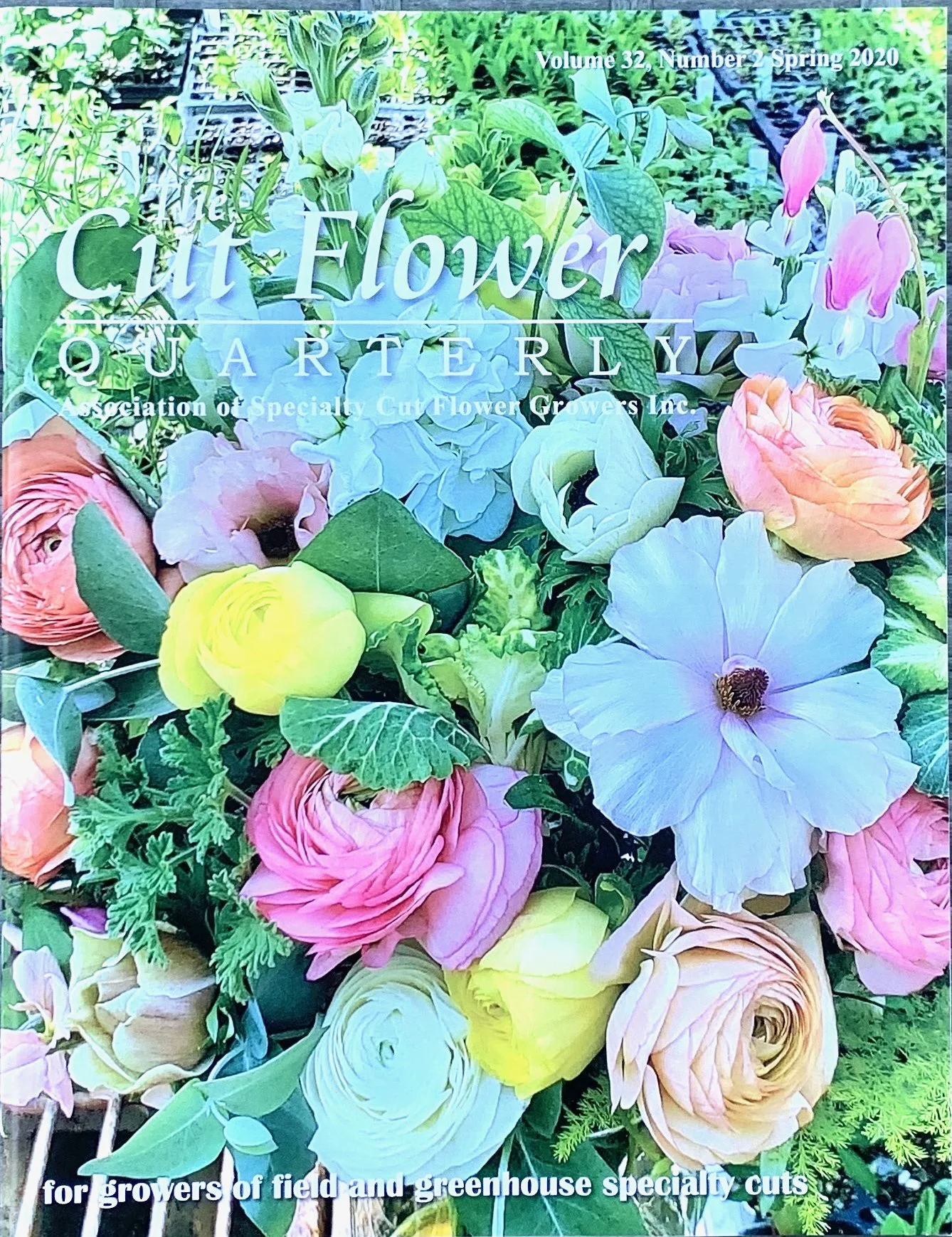
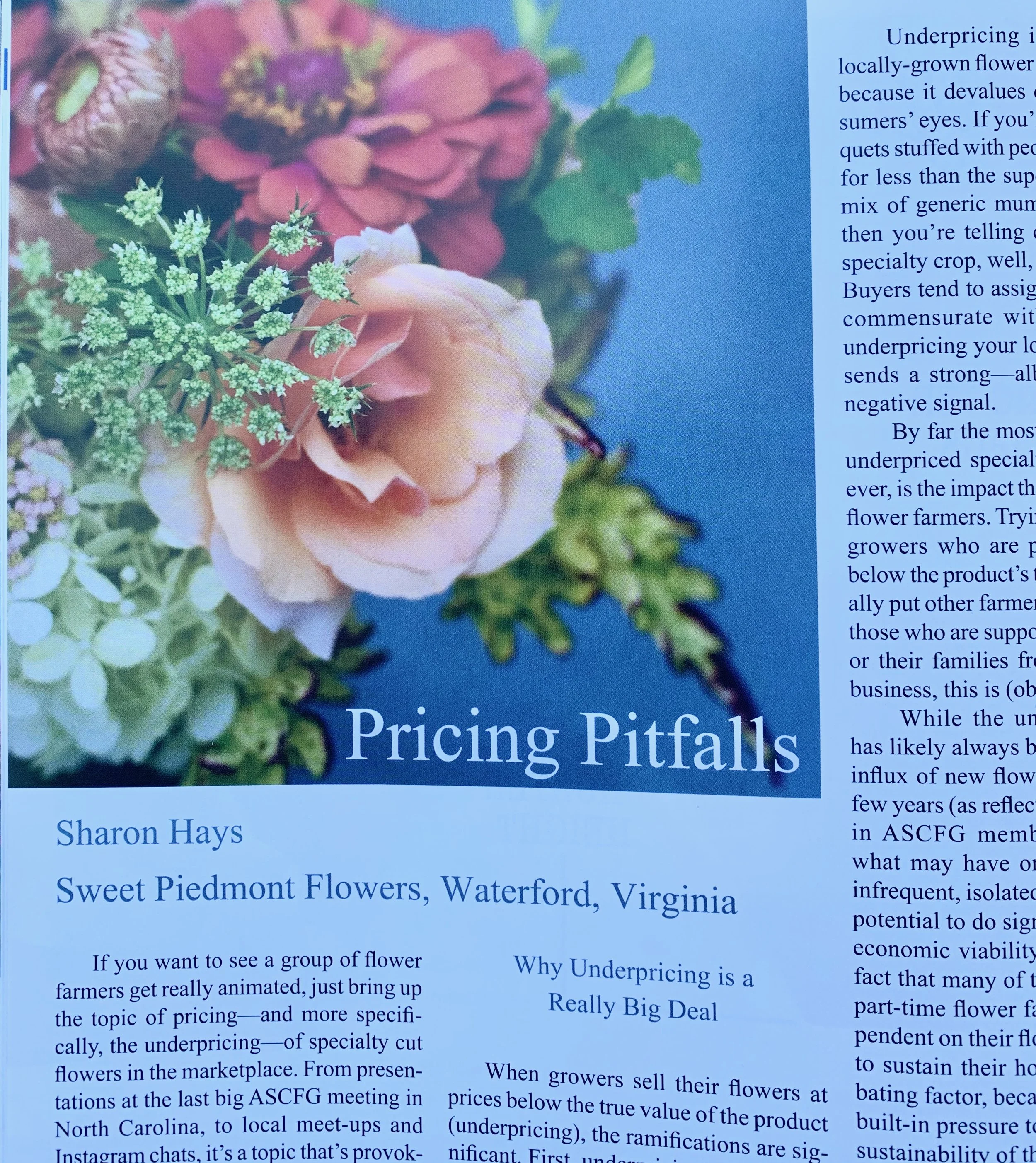
I’ve been working on solving the pricing puzzle for a very long time. I first wrote an article about it in the ASCFG Cut Flower Quarterly back in 2020.
From Janky Spreadsheets to Something Real
I’m not a mathematician, but I love this kind of problem — the kind that looks messy and unsolvable on the surface, and then slowly reveals a structure underneath. The kind where numbers, logic, and creativity can all peacefully coexist.
At first, my “tool” was laughably clunky. A sprawling Excel file with solver equations that had to be rewritten every time I changed the size of a bouquet or shifted from spring to summer. It worked, technically — but only if I was the one using it, and only if I was willing to babysit it.
The spreadsheet may have been fragile, but the numbers worked. The logic held. It was possible to build beautiful, balanced bouquets within clear pricing guardrails.
And that’s when the next challenge appeared.
Solving pricing for myself was one thing. Turning that solution into something another grower could actually use was something else entirely.
I started by writing the logic down — the roles flowers play, and the way those roles repeat from season to season. From there came recipes. Not rigid formulas, but seasonal structures that could flex with availability while still holding together visually and financially. That work became the basis of the Bouquet Blueprint™.
But if my pricing solution was going to be genuinely usable for others, the math — and the spreadsheets it lived in — needed to disappear into the background. The problem with that? Well, I’m also not a software engineer.
So I took an online, introductory Python coding class. I still had my day job then, which meant working on this problem late at night, on weekends, and during breaks between farm chores. Since leaving my day job, there have been days I spent upwards of 18 hours at my computer, trying to write the computer code for the tool. I quit more times than I can count. The amount of frustrated tears I shed could have probably filled a small Procona.
But I love puzzles. And this one was endlessly interesting to me.
With time — and a lot of help from modern tools (“vibe coding” wasn’t yet a thing, but I took advantages of its early precursors) — I was able to translate the framework, the recipes, and the pricing logic into something a computer could handle consistently, both in terms of the number crunching behind the scenes, and a user interface that made inputting information quick, easy, and understandable.
That work became The Bouquet Pricing App.
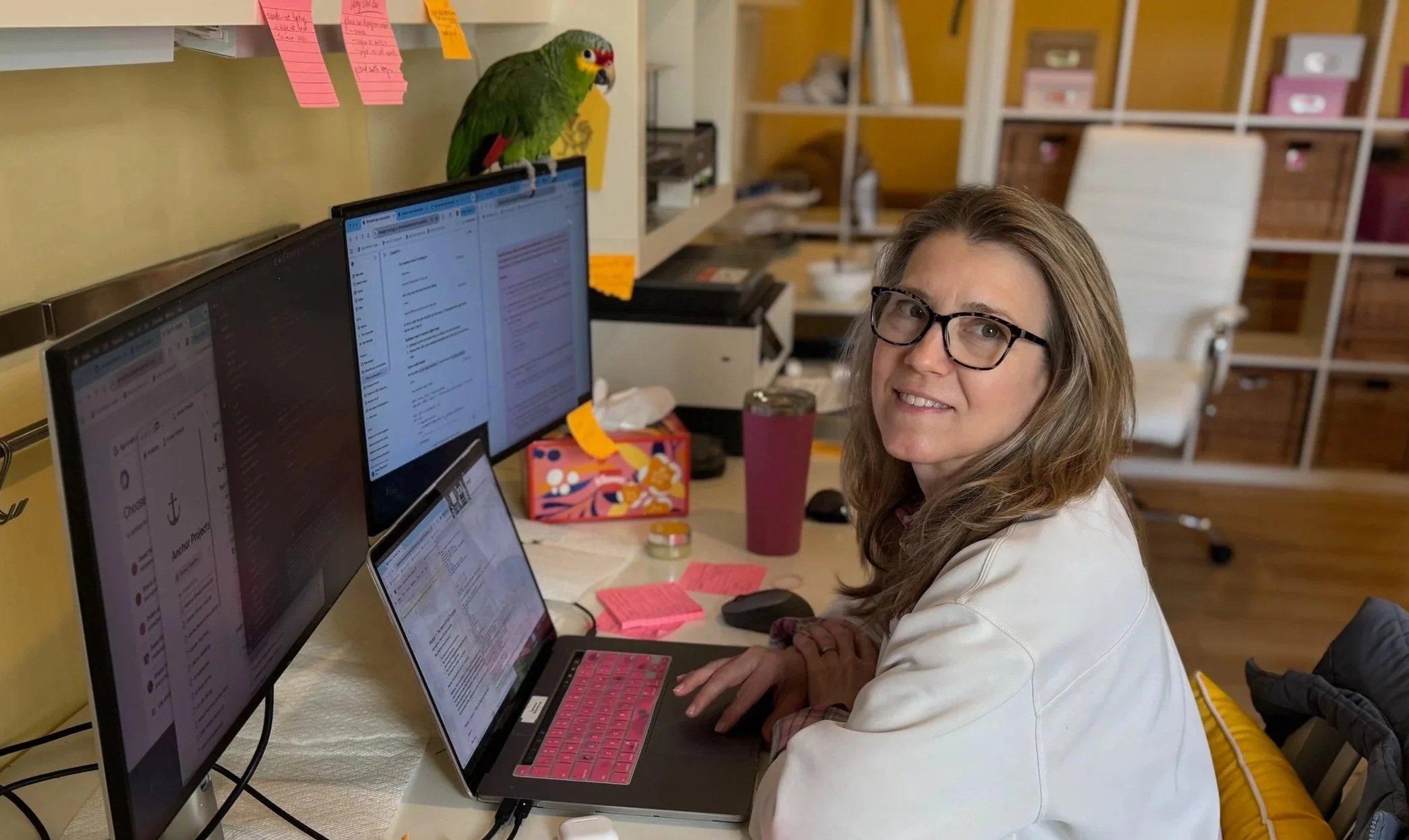
I’d rather have my hands in the dirt than be typing on a keyboard, but cracking the code on pricing meant spending hours in front of the computer. At least I always had at least one of our animals nearby for company.
Pricing Help Is Here, Finally
So if pricing your mixed bouquets has been the thing holding you back — the part you avoid, overthink, or leave until the last possible moment — this is exactly the problem the Pricing App was designed to solve.
This approach isn’t meant for everyone. If you’re growing primarily for straight-bunch wholesale, other methods will serve you better.
But if you’re making mixed bouquets — for farmers markets, subscriptions, or any other sales channel where mixed bouquets are part of your product line-up — this was built specifically for the way you work.
If I’d had this tool back on that 4am morning, I still would have been nervous. Putting your flowers out into the world for the first time comes with at least a flutter of apprehension, for many of us.
But I wouldn’t have been erasing chalk pen ink and rewriting prices over and over again, trying to talk myself into numbers I didn’t trust. And I might have even been able to grab a couple hours of sleep before heading to the market. So if you’re experiencing any of the same challenges, do yourself a favor and check out the pricing app.
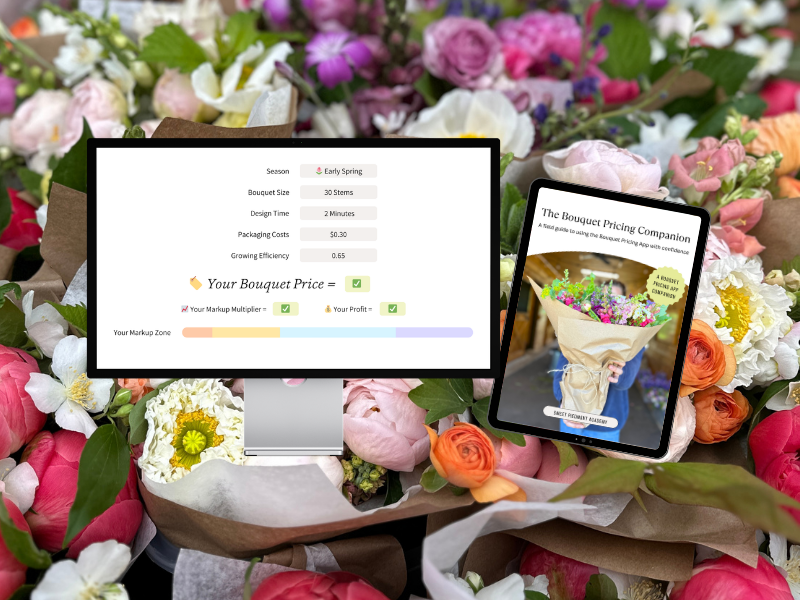
The Bouquet Pricing App
Turn your farm's real costs into an accurate, profitable bouquet price in seconds, no spreadsheets, no guesswork.
Get your ideal selling price, markup, and profit per bouquet
Test different stem counts, costs, and prices before you sell
One-time purchase, includes a free companion guide